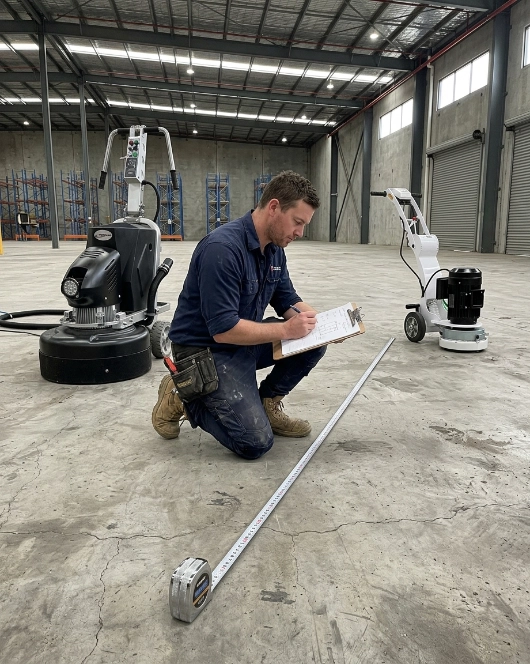
When quoting a concrete grinding job, it’s tempting to work backwards from the floor area.
You’ve got 500 square metres to grind, your machine can cover a certain amount of floor per hour, so you calculate the hours, add a bit of time and put together your quote.
Sounds simple enough.
But anyone who’s spent time behind a concrete grinder knows that production rates aren’t quite that straightforward.
Two jobs with exactly the same floor area can take vastly different amounts of time to complete. And if you base your quote on square metres alone, you could find yourself working a lot harder than you planned.
Here’s what really affects concrete grinding production rates.
1. What are you actually trying to achieve?
Not all grinding jobs are created equal.
Are you removing a light coating? Taking off a thick epoxy system? Flattening an uneven slab? Preparing a surface for a new coating? Or working towards a particular concrete finish?
Each task places different demands on the machine and tooling.
A light surface grind might move along relatively quickly, while aggressive coating removal or substantial concrete correction can take considerably longer.
Before estimating production, be clear about the required outcome. The amount of material that needs to come off the floor is often more important than the size of the floor itself.
2. The concrete has a say in the matter
Concrete isn’t a consistent material.
One slab might grind easily, while another can be extremely hard and slow to work. Aggregate type, cement content, surface condition and previous treatments can all influence how the tooling performs.
Even floors within the same building can behave differently.
This is one reason why making assumptions about production rates can be risky. Experience helps, but a small test area is often worth the time before committing to a full job.
It gives you a much better idea of how the floor responds and whether your tooling selection is suitable.
3. Your tooling selection makes a difference
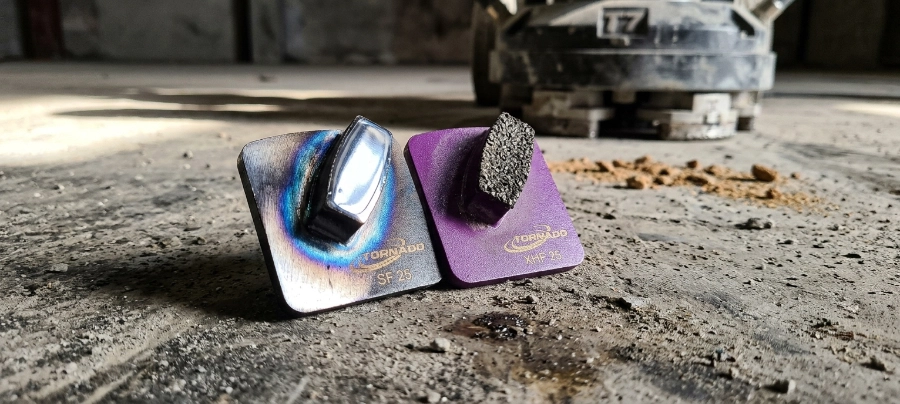
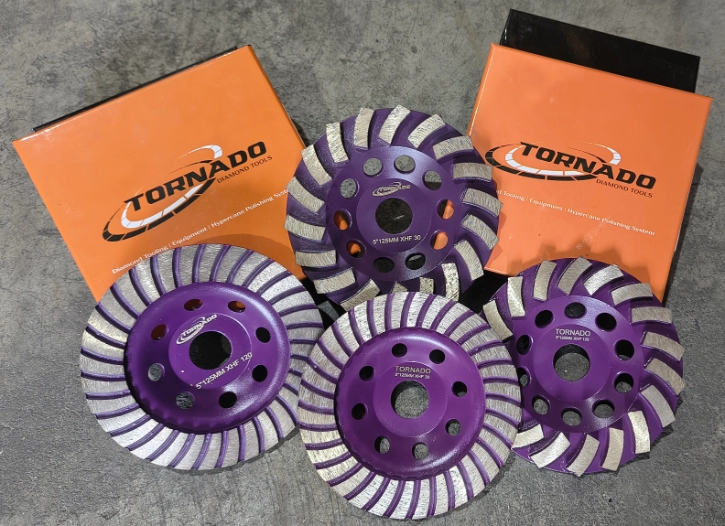
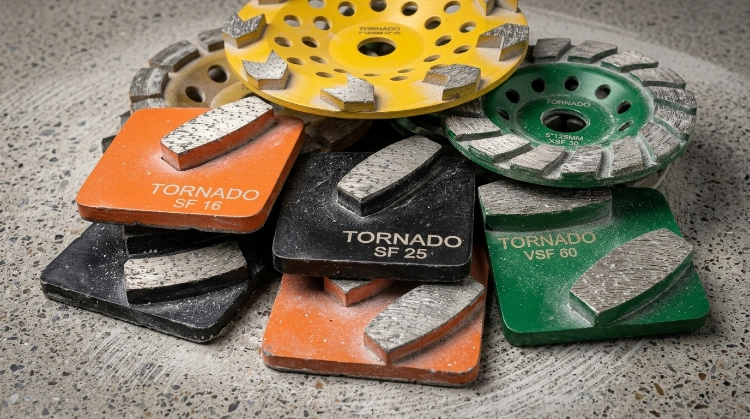
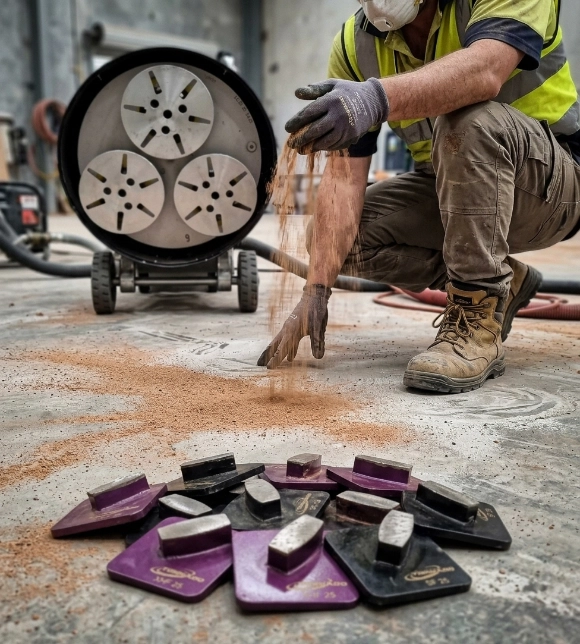
The right diamond tooling is a major part of getting the job done efficiently.
Tooling needs to suit the concrete, the material being removed and the result you’re trying to achieve.
A tool that works well on one floor may not be the best choice for another. If the tooling isn’t suited to the application, you can end up with poor cutting performance, unnecessary wear or time lost changing tools and trying different combinations.
The objective isn’t simply to find the most aggressive diamond available. It’s to find the right combination of cutting performance, tooling life and finish for the job.
A little time spent selecting the right tooling at the start can save a lot of time later.
4. Machine size isn’t the whole story
It’s easy to assume that a bigger grinder will always get the job done faster.
A larger machine can certainly offer advantages, particularly on open floor areas where it can work efficiently. But machine size alone doesn’t determine production.
Consider the entire setup:
- Machine weight and available grinding pressure.
- Number of grinding heads and tooling configuration.
- The condition and suitability of the tooling.
- The operator’s experience and technique.
- The amount of floor that can be accessed efficiently.
A machine that’s well matched to the job will often outperform a larger machine that’s poorly suited to the conditions.
5. Don’t forget the time that isn’t spent grinding
Here’s where a lot of production estimates can fall apart.
The grinder might be capable of covering a substantial area, but the machine isn’t grinding every minute of the working day.
Think about all the other tasks involved:
- Moving equipment between work areas.
- Setting up power and dust extraction.
- Changing tooling.
- Working around columns, walls and obstacles.
- Managing edges and difficult access areas.
- Cleaning up and preparing for the next stage.
These activities all take time, and they need to be included when estimating the overall job.
A machine’s theoretical production rate and the actual amount of floor completed in a day are two very different things.
6. Keep track of your own production rates
One of the best ways to improve your quoting accuracy is to keep records of completed jobs.
Record the floor area, type of concrete, tooling used, machine setup, material being removed and the time taken.
Over time, you’ll start building a useful picture of how your equipment and tooling perform in different conditions.
You don’t need an elaborate spreadsheet or complicated software. Even basic job records can help you make better estimates and identify where time is being lost.
And when you find a tooling combination that performs particularly well, you’ll have something concrete to refer back to next time.
The bottom line
Concrete grinding production isn’t just about how quickly your machine can travel across a floor.
It’s about matching the machine and tooling to the concrete, understanding what’s required and allowing for everything involved in completing the job.
The more accurately you understand those variables, the better you’ll be able to estimate jobs, manage your time and protect your margins.
At Tornado Diamond Tools, we know that getting the right equipment and tooling combination matters. If you’re unsure which tooling is suited to your next application, talk to us. We’d rather help you get the setup right before you start than have you spend half a day fighting the wrong diamonds.
What’s your biggest factor when estimating a grinding job? Is it the concrete, the tooling, the machine setup or something else entirely? Let us know in the comments. We reckon there’s plenty of experience out there worth sharing.