Ask any concrete prep contractor where jobs slow down, and they’ll rarely point to the middle of the floor. Main floor runs with heavy planetary machinery are straightforward when speed and weight are on your side. The real test happens around the perimeter—edging along walls, around columns, and in tight doorways with a 5″ angle grinder.
When you hit a dense, power-troweled, or burnished slab, hand-grinding edges can quickly become a nightmare. Either your cup wheel glazes over instantly—spinning red-hot without biting into the surface—or it chatters violently, leaving deep swirl marks and gouges that require hours of meticulous correction.
Mastering edge prep on extra-hard substrates comes down to understanding tooling mechanics, selecting the right bond matrix, and adopting proper hand-grinding technique.
The Core Rule: Opposite Bonds for Opposite Concrete
The most common mistake on site is treating all concrete the same when selecting hand tooling. The fundamental rule of diamond grinding applies just as strongly to 5″ cup wheels as it does to massive planetary grinding shoes:
- Hard Concrete requires a Soft Bond. Dense, non-abrasive slabs don’t wear down the metal matrix easily. You need an extra-soft bond matrix that wears away deliberately under friction to expose fresh, sharp diamond particles continuously.
- Soft/Abrasive Concrete requires a Hard Bond. Green, sandy, or rain-damaged concrete wears metal quickly. A hard bond holds onto the diamond grit longer so the wheel isn’t destroyed in minutes.
If you run a standard or hard-bonded cup wheel on a dense, hard slab, the matrix refuses to wear. The diamond tips dull down, friction spikes, the head glazes over, and you end up polishing the concrete rather than grinding it.
Why Hand Edging Requires Higher Precision
Hand-grinding presents unique challenges compared to running a walk-behind machine:
- High RPM, Low Mass: Angle grinders operate at significantly higher RPMs than floor machines, generating heat faster. Without massive downward machine weight to force mechanical bite, the diamond matrix must do 100% of the cutting work.
- Manual Angle Control: Holding a grinder by hand makes it easy to tilt the tool slightly off-axis. Too much tilt puts all the pressure on a tiny edge segment, digging gouges into the floor that show straight through thin-film coatings.
What to Look for in a High-Performance Cup Wheel
When tackling extra-hard concrete perimeters, look for specific engineering features in your cup wheel design:
1. High Segment Density
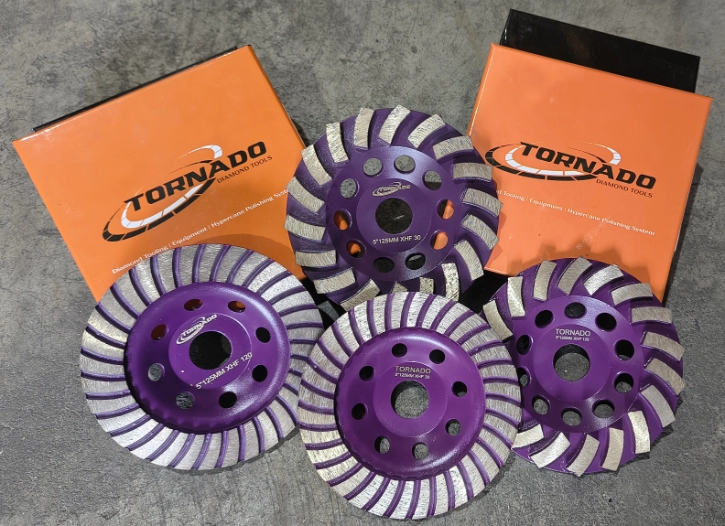
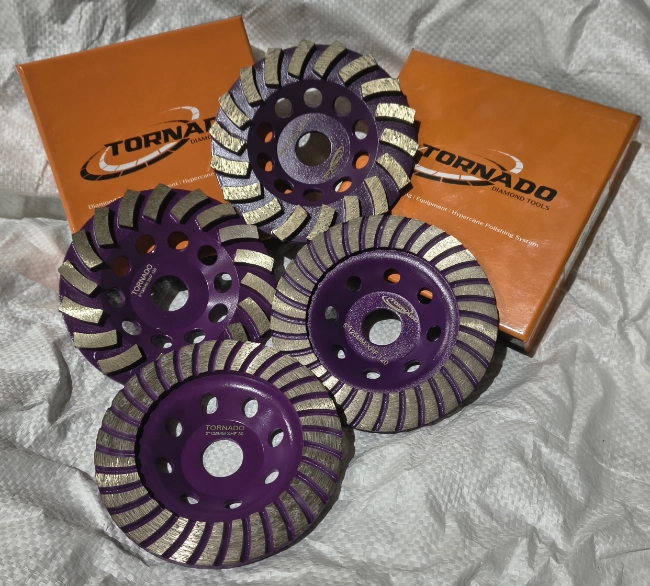
Single or double-row segment layouts concentrate weight on fewer points, which can cause aggressive chatter on dense floors. An 18-segment or even 33-segment design spreads the surface contact evenly across the wheel circumference. This creates a stable, chatter-free grind that floats smoothly over the floor, preventing the tool from biting in too aggressively on one edge. The high segment density provides a controlled grind for a buttery smooth finish.
2. Specialized Extra-Soft Matrix (XHF)
For burnished or dense concrete, standard tooling won’t cut it. You need a specialized matrix—like an Extra Hard Floor (XHF) soft-bond compound—specifically formulated to keep cutting without heat-glazing.
3. Balanced Grit Selection (30 Grit)
While coarse 16-grit tools rip through soft coatings, a 30-grit configuration strikes the ideal balance for hard concrete. It provides a sharp, aggressive bite while leaving a smooth, uniform surface profile ready for primers, epoxies, or polishing steps. Use finer grit options like 60, 80 and 120# for exposed and polishes finishes.
Site Checklist: Tips for Cleaner Edges
To protect your wrists, your equipment, and your finish quality on site:
- Let the Tool Work: Avoid leaning your full body weight onto the angle grinder. Forcing downward pressure causes thermal buildup, accelerating glaze and overheating your grinder motor.
- Keep the Shroud Flat: Keep the vacuum shroud flush against the slab. Riding on an angle ruins the suction seal, releasing harmful silica dust into the air and unevenly wearing the leading segments.
- Dress Glazed Wheels: If a wheel glazes over from improper use or hitting a soft patch, strip back the metal matrix and re-expose sharp diamonds by running it for a few seconds across an abrasive brick, a section of soft, sandy concrete, or even a slightly damp slurry of course concrete dust.
Match the Tool to the Challenge
Edge work doesn’t have to be the bottleneck that holds up your crew. By equipping your team with specialized tooling engineered for dense substrates, you eliminate edge gouging, stop heat glazing before it starts, and achieve a consistent finish right up to the wall. High segment density 5″ cup wheel options such as Tornado’s DT51830XHF PURPLE 18 segment 30# cup wheel and CYC530XHF 33 segment 30# provide exactly the sort of control to tame the edges, with finer grit options available to tackle exposed or polishes finishes.
Need help selecting the right diamond tooling for your next job site? Visit your local Tornado Diamond Tools stockist or explore our full range of surface prep solutions here.