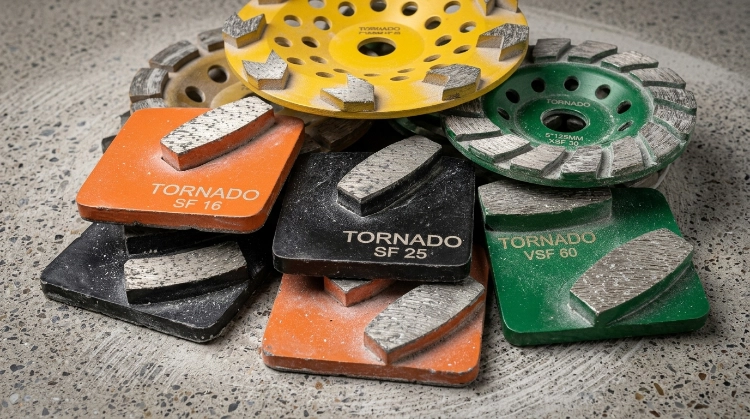
Understanding diamond tooling fundamentals is essential for selecting the correct tooling, maximizing productivity, and managing job costs effectively.
1. Fundamentals of Diamond Tooling
The Diamond
Synthetic diamonds perform the actual cutting and grinding. Diamond size is measured by mesh/grit size, which has an inverse relationship to physical diamond size:
- Coarse / Low Grit (e.g., 16 Grit): Contains larger, fewer diamond particles. Best for aggressive stock and coating removal.
- Fine / High Grit (e.g., 80+ Grit): Contains smaller, more concentrated diamond particles. Best for fine scratch removal and polishing.
The Bond
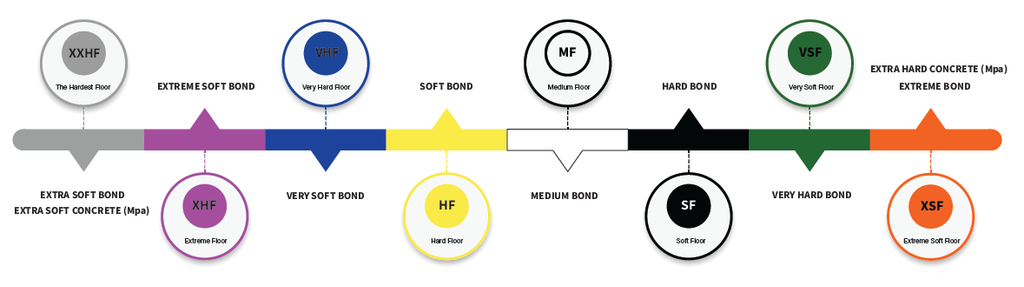
The bond holds the diamonds in place and is engineered to wear away at a controlled rate, exposing fresh diamond edges. Matching bond hardness to concrete hardness is critical:
- Soft Concrete (Abrasive): Yields high dust volume (e.g., 5+ bags per 100m2). Requires a Hard Bond (high wear resistance) to prevent premature tool wear.
- Hard Concrete (Non-Abrasive): Yields minimal dust (e.g., 1 bag per 100m2). Requires a Soft Bond (low wear resistance) so the matrix breaks down fast enough to release new sharp diamonds.
Rule of Thumb: Opposites attract. Soft concrete needs a Hard bond; Hard concrete needs a Soft bond.
2. Tooling Selection Guide
Grit Selection Breakdown
| Grit Level | Tooling Type | Primary Application DOCX |
| PCD | Polycrystalline Diamond | Heavy coating removal (thick epoxies, membranes). Does not grind concrete. |
| 6 Grit + PCD | Hybrid Segment | Heavy coating removal while simultaneously grinding concrete. |
| 6 – 16 Grit | Metal Bond | Heavy surface preparation on coatings and hard concrete (CSP 3–4). |
| 25 Grit | Metal Bond | Standard surface preparation for general concrete substrates. |
| 30 / 40 Grit | Metal Bond | All-round preparation tool; typical initial cut for polished concrete. |
| 60 / 80 Grit | Metal Bond | Secondary pass for polished concrete or final pass for grind-and-seal. |
| 120 / 150 Grit | Metal Bond | Final metal pass to remove previous scratch patterns prior to resin steps. |
| 30 – 3000 Grit | Resin Bond | Fine honing and high-sheen polishing passes for concrete and overlays. |
Segment Shapes
- PCD: Aggressive coating scraping; does not grind concrete.
- Arrow / Star: Designed for high-point contact to shear off carpet/tile glues, epoxies, and thin coatings (typically 25 grit).
- Step: Ideal for thin roll-coat epoxies, carpet glue, and thin vinyl adhesives (typically 25 grit).
- Coffin / Rectangle: General-purpose concrete grinding and light coating removal across all metal grits (6–150 grit).
3. Performance & Cost Analytics
To optimize job profits, track tooling performance and real costs rather than relying on initial purchase price.
Calculating Production Rate
Track total square meters ground against actual grinder run-time (excluding downtime):
ProductionRate(m2/hr)=AreaGround(m2)/ActualGrindingTime(hrs)
Example: 465m2 ground in 7 hours =66.4m2/hr production rate.
Calculating Diamond Tooling Cost
Determine wear cost per square meter by dividing set purchase price by total yield:

Example: A $350 set yielding 500m^2 = $0.70/m^2 tooling cost.
4. Operational Recommendations
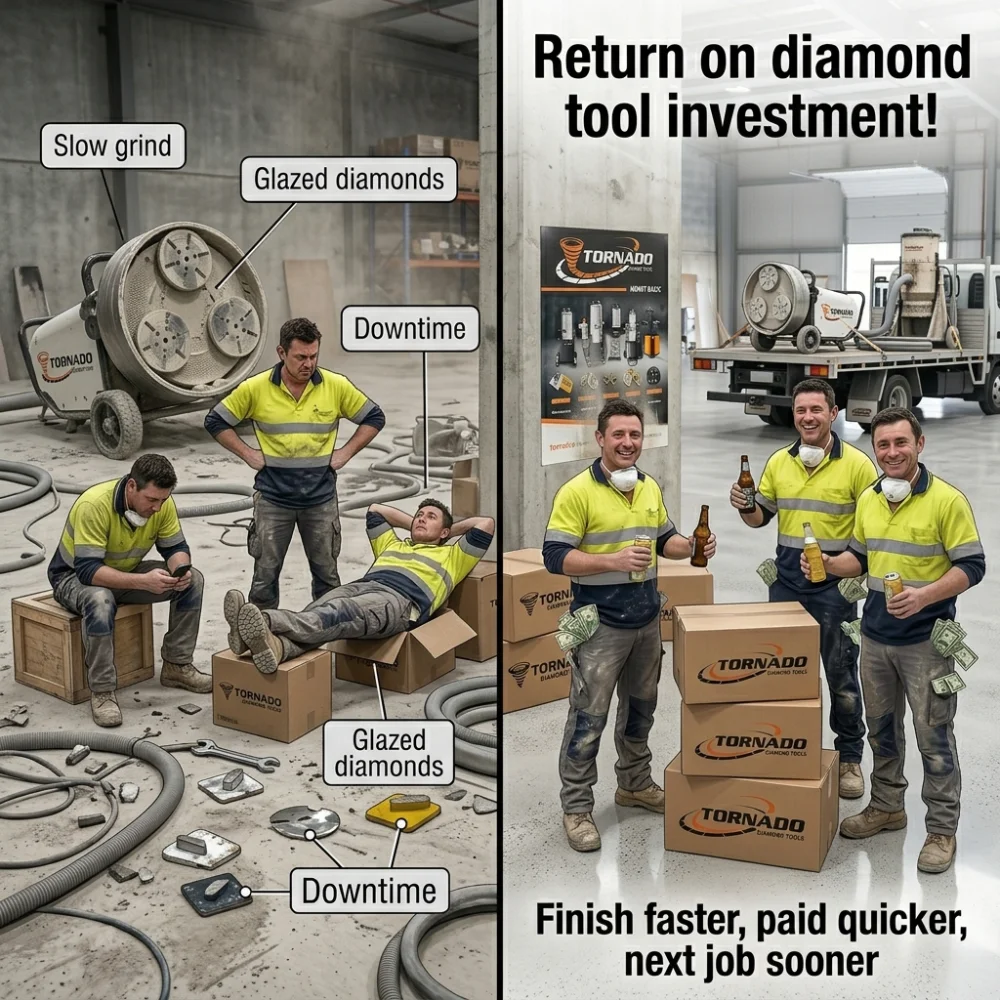
Invest in quality diamond tools to minimise downtime onsite and ensure a return on the most expensive component of any job – your labour force investment.
- Maintain Inventory Diversity: Always keep standard grit ranges and bond hardness options on-site to match varying field conditions immediately.
- Log Performance Data: Keep a dedicated job log (floor condition, machine model, diamond bond, yield, production rate) to make data-driven tooling decisions.
- Audit Tooling Annually: Test new diamond formulations at least once every 12 months to benefit from ongoing manufacturing advancements.
5. Lock and load
Now that you’ve got the fundamentals down, all it takes is a little curiosity, a bit of trial and error, and the drive to experiment. Real expertise on the floor comes from hands-on experience—and every mistake is just data for your next job.
Knowledge is power, success follows effort, and comfort zones don’t build businesses. Get out there, test your tools, and outsmart the competition.